
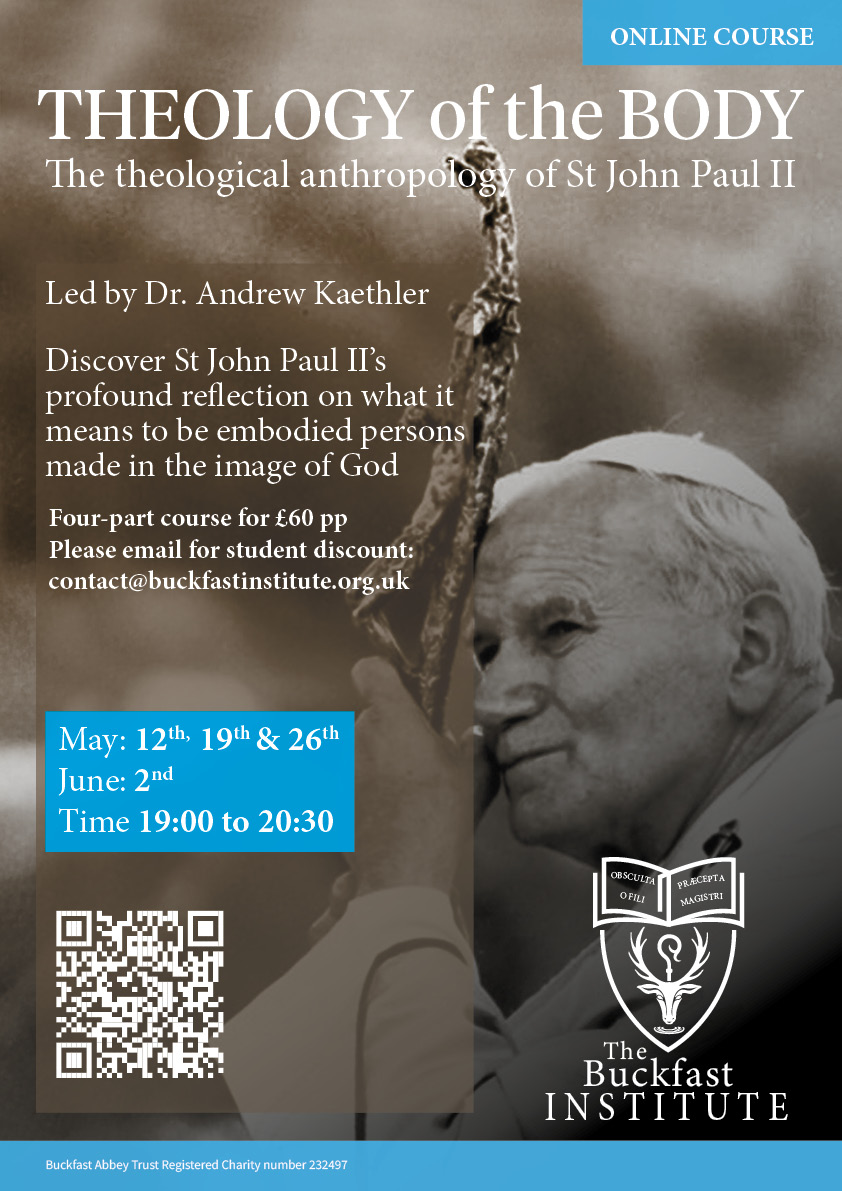
A Four-part online course for £60pp. Each session starts at 19:00 and ends at 20:30 hrs. For student discounts please email contact@buckfastinstitute.org.uk
What does it mean to be a human person? How are our bodies—male and female—a means of knowing God? Why is marriage at the heart of salvation history? St. John Paul II’s theological anthropology, known as Theology of the Body, provides a response to these questions by opening a door into the great mystery of being made in the image of God. Join Dr. Andrew Kaethler and explore St. John Paul II’s vision of the human person.
Find out more about Dr. Andrew Kaethler HERE.
Theology of the Body Series:
1. The Interior Exterior Person
How do our bodies shape what it means to be a person? What does our sex, male or female, reveal to us about ourselves and about God? These questions and more will be explored through St John Paul II’s theological notion of original solitude. This session sets out the foundation for the Church’s teaching on the sacrament of marriage.
2. Communion of Persons
By unpacking St John Paul II’s read of Genesis chapter one and two and the theological notions of original innocence, original unity, and original nakedness, this session will set out the theological conviction that a person is one who is in relation. In light of this, we will explore how redemption is the overcoming of autonomous individualism.
3. The Nature of Love and Its Demands
What is love? Is love free? If love is free, can it have demands? What is the relation between love and desire? Are love and responsibility intimately related?
4. Justice and Sex
Is there a foundational ordering to the sexual relationship between a man and woman? In this session we will explore how justice is the basis of Catholic teaching on marriage, procreation, and Natural Family Planning.